
China Top 10 LED Solar Street Light Manufacturers?
China’s LED solar street light industry has grown from basic outdoor lamps into a competitive engineering sector. Manufacturers now combine high-efficiency LED modules, lithium batteries, intelligent controllers, and photovoltaic panels. Yet product quality differs widely. A bright sample unit does not always guarantee reliable lighting after several cloudy nights.
This guide introduces ten leading Chinese manufacturers of LED solar street lights. The selection considers manufacturing experience, product range, lighting performance, battery safety, weather resistance, certifications, warranty support, and overseas project records. Practical details matter. A well-designed lamp should illuminate a road evenly, charge efficiently, and protect its battery inside a sealed enclosure. It should also survive dust, rain, heat, and repeated temperature changes. Professor Martin Green, a leading photovoltaics researcher, has said, “Solar energy is the most abundant energy resource available to humanity.” His statement explains the opportunity, but not every solar product uses that opportunity well. Careful comparison remains necessary.
These companies may serve different needs, from village pathways to highways and commercial compounds. Some emphasize integrated designs. Others focus on split systems, smart controls, or large infrastructure projects. Their rankings should not be treated as permanent. Prices, technologies, export records, and factory capabilities can change. Even respected suppliers may have weaknesses, including limited customization or inconsistent regional service. That is worth admitting. Buyers should verify test reports, lighting simulations, battery specifications, installation records, and after-sales terms before signing a project contract. This overview aims to make that investigation clearer, not replace it.
What Are LED Solar Street Lights and How Do They Work?
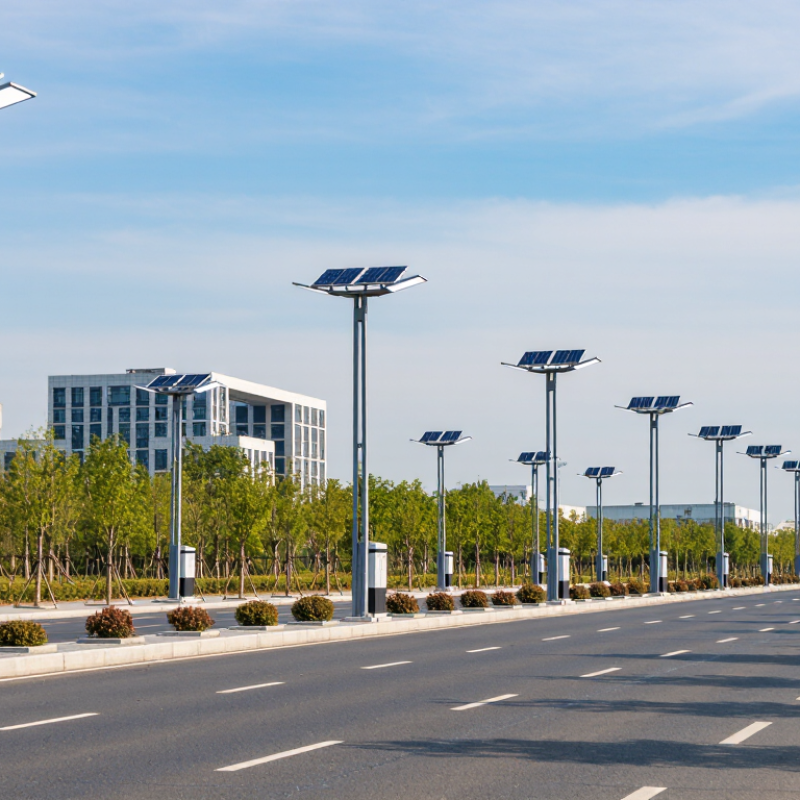
LED solar street lights combine a photovoltaic panel, LED fixture, battery, controller, and mounting structure. During daylight, the panel converts sunlight into electricity and charges the battery. After sunset, the controller powers the LED fixture automatically. A light sensor or timer manages switching.
The International Energy Agency Photovoltaic Systems Programme reported about 456 gigawatts of new solar capacity worldwide in 2023. This growth supports wider solar infrastructure adoption, including outdoor lighting. The U.S. Department of Energy notes that modern LED packages can exceed 150 lumens per watt under suitable conditions. However, complete street-light performance depends on optics, temperature, battery quality, and installation design.
A reliable manufacturer should show test data, not only attractive lumen claims. Look for battery capacity, operating hours, charging efficiency, protection ratings, and photometric files. A typical system may use a 30–80 watt LED fixture, depending on road width and pole spacing. Real sites are less tidy. Shade from trees, dust, winter clouds, and poor panel angles can reduce charging. The Global Off-Grid Lighting Association also emphasizes that product quality and after-sales service influence long-term off-grid performance. A cloudy week can expose weak sizing. For buyers comparing China’s top ten suppliers, independent testing and field records deserve more attention than factory scale alone.
| No. | Evaluation Dimension | Typical Industry Data | What It Means for LED Solar Street Lights |
|---|---|---|---|
| 1 | LED Light Source | High-efficiency LED modules; commonly 100–200 lm/W at system level | LEDs convert electrical energy into light. Higher efficacy can provide the required road illumination with lower battery and solar-panel capacity. |
| 2 | Solar Panel Technology | Monocrystalline silicon panels, commonly 18%–23% module efficiency | The photovoltaic panel converts sunlight into electricity. Panel output varies with sunlight intensity, temperature, orientation, shading, and seasonal conditions. |
| 3 | Battery Chemistry | Lithium iron phosphate (LiFePO₄) is widely used; lead-acid remains available for some projects | The battery stores daytime solar energy for nighttime operation. LiFePO₄ batteries generally offer good thermal stability, usable depth of discharge, and cycle life when properly managed. |
| 4 | Battery Autonomy | Approximately 2–5 nights without sufficient solar charging | Autonomy indicates how long the light can operate during cloudy or rainy weather. The required value depends on local climate, operating hours, and the selected dimming profile. |
| 5 | Lighting Control | Photocell or solar-charge-controller activation with programmable dimming | The controller turns the lamp on at low ambient light and off after sunrise. Multi-stage dimming can reduce energy consumption during low-traffic hours. |
| 6 | Protection Rating | IP65 or higher for outdoor luminaire and electronics enclosures | The first IP digit concerns protection against solid objects and dust, while the second concerns water ingress. The rating should match the installation environment and enclosure design. |
| 7 | Mechanical Impact Resistance | IK08–IK10 may be specified for the luminaire housing | The IK rating describes resistance to mechanical impact. Higher ratings can be useful in public areas exposed to vandalism, accidental contact, or severe weather. |
| 8 | Corrosion and Operating Conditions | Typical outdoor designs support approximately −20°C to 50°C, subject to component selection | Aluminum housings, protective coatings, sealed connectors, and suitable battery-management systems help improve reliability in humid, coastal, dusty, or temperature-variable locations. |
| 9 | Expected Service Life | LED module: commonly rated up to 50,000–100,000 hours; battery life depends on cycles and temperature | LED lifetime is normally expressed using an L70 rating, meaning the light output is expected to remain at approximately 70% of its initial value under specified conditions. Battery replacement timing is project-dependent. |
| 10 | Compliance and Project Verification | Photometric data, electrical safety documentation, EMC testing, and applicable regional certifications | A reliable supplier should provide test reports, datasheets, installation guidance, warranty terms, and real project information. Road-lighting performance should be verified against the applicable local lighting standard. |
| How the system works: During daylight, the solar panel generates electricity and the charge controller stores it in the battery. At night, a light sensor or programmed controller powers the LED fixture. The controller can regulate brightness, protect the battery from overcharging and excessive discharge, and adjust operation according to the selected lighting schedule. | |||
Related Posts
-

How to Choose Solar LED Lights for Global Sourcing?
-
Why Choose Solar LED Lighting for Your Home and Environment?
-

Best Solar LED Lights for Home Use in 2026?
-
2026 Top Solar LED Products Buyers Guide for Global Sourcing?
-

Illuminate Your Outdoors with Solar LED Lights for a Sustainable Lifestyle
-

Top 10 Tips for Choosing LED Solar Solutions for Your Needs?