Why Choose a Laser Meter for Accurate Measurements?
Accurate measurement is the quiet foundation of reliable construction, renovation, surveying, and interior planning. A small error on a wall can become a costly problem across an entire room. This is where a Laser Meter offers practical value. It sends a laser beam toward a target, then calculates distance with impressive speed. The result appears clearly on a compact screen, often within seconds.
Dr. John M. Rüeger, a respected authority in electronic distance measurement, offers an important reminder: “The quality of a measurement is not determined by the instrument alone, but by the complete measurement process.” His point remains highly relevant. Even an advanced Laser Meter needs a steady hand, a visible target, and correct positioning. Glass, dark surfaces, bright sunlight, and uneven edges can affect readings. Accuracy is not magic.
It is a disciplined habit.
In real work, a professional may measure a doorway twice, check the reference point, and compare the result with a tape measure. That extra minute can prevent a wrong cut, a misplaced cabinet, or a failed installation. Modern models may also calculate area, volume, height, and indirect distances. These functions save time, but they can also invite overconfidence. I once assumed a quick reading was automatically reliable; that assumption was careless. The better approach combines technology with judgment.
Choosing a Laser Meter, therefore, is not only about maximum range or display features. It is about repeatable accuracy, clear operation, durable construction, and honest performance in everyday conditions. A dependable device supports better decisions, especially when every millimeter matters.
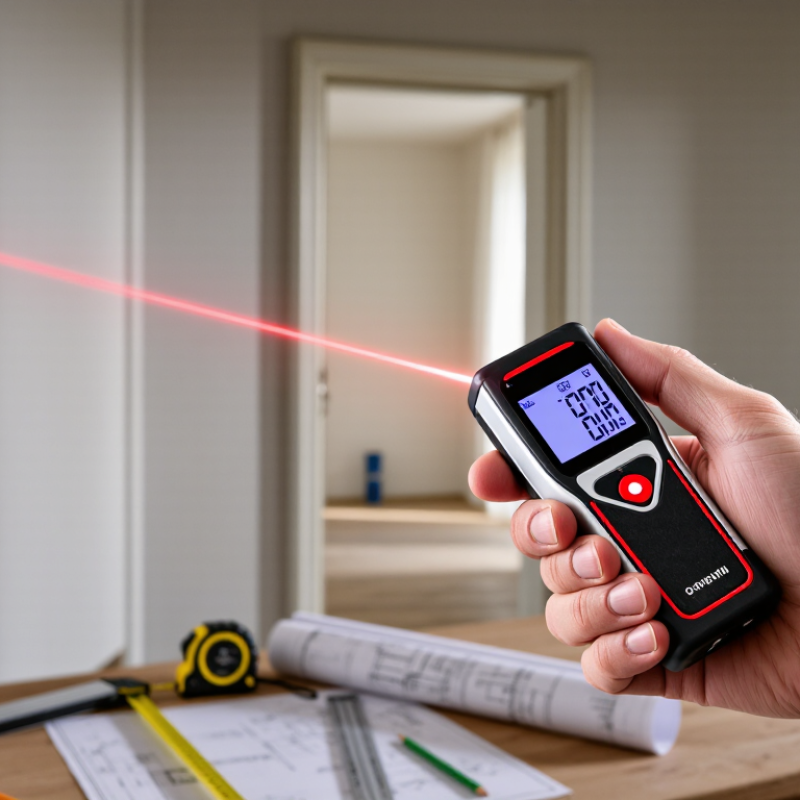
What a Laser Meter Is and How It Measures Distance
A laser meter is a handheld tool that estimates the distance between its measuring point and a target. It sends out a narrow beam of light, then detects light reflected from the surface. The device calculates distance from the signal’s travel time or a change in its phase, depending on its design. The displayed result may look instant. The calculation behind it is precise.
To measure a room, place the meter against a stable wall and aim at the opposite surface. Check which edge or point the instrument uses as its reference; a small offset matters when measuring a tight opening. Press the measure button and keep the device steady until the reading appears. Repeat the measurement if the beam lands near a corner or trim. Small details count.
Surface and conditions affect results. A matte wall usually gives a cleaner return than dark fabric, shiny tile, or glass. Bright sunlight can also make the target harder to detect, especially outdoors. If a reading seems odd, move the aim slightly and compare it with a tape measure. Neither tool is perfect in every situation. I’d treat one unexplained reading with caution, rather than assuming the meter—or the operator—must be right.
How Laser Technology Produces Precise Readings
A laser meter measures distance by sending a focused beam toward a surface and analyzing the light that returns. Depending on its design, it calculates distance from the beam’s travel time or a change in the returned signal’s phase. The instrument then converts that information into a reading, often within seconds.
No tape to stretch. No helper needed.
A small laser spot makes it easier to aim at a specific point, such as the far corner of a room or the edge of a window frame. This can reduce errors caused by a sagging tape or a misread mark. But the beam still needs a clear path. Glass, shiny surfaces, dark materials, and strong sunlight can affect the return signal. A tilted target can also shift the reading.
For dependable results, hold the meter steadily and place it against the same reference point each time. Check whether the instrument measures from its front or rear edge; that setting can change the result. Take a second reading when a dimension matters. A laser display can look precise, but precision is not the same as guaranteed accuracy. I would not trust one measurement blindly, especially across a long, bright room.
Factors That Affect Measurement Accuracy
Why Choose a Laser Meter for Accurate Measurements?
Factors That Affect Measurement Accuracy
A laser meter can deliver quick, repeatable readings, but the displayed number is only as dependable as the setup. Distance, target surface, beam angle, and movement all matter. A dark, rough wall may return a weaker signal than a pale, flat surface. Glass can create extra reflections, while a tilted beam may measure a longer path than intended. Bright sunlight can also make aiming and reading the display harder. Small errors add up.
Temperature and instrument condition deserve attention too. Materials expand as they warm, and a meter that has been dropped or poorly stored may need checking. ISO 16331-1:2012 describes test methods for handheld laser distance meters, so compare performance under defined conditions rather than relying on a single headline accuracy figure. NIST Technical Note 1297 explains that expanded measurement uncertainty commonly uses a coverage factor of k=2, corresponding to about 95% coverage when the relevant statistical assumptions apply. A reading is not certainty.
Tips: Keep the meter square to the target, clean its lens, and use a solid reference point. Take three readings; investigate noticeable differences instead of averaging them away. On a sunny site, shade the target if practical. I still find that rushed aiming causes avoidable variation. Check the manual’s stated operating range and accuracy conditions before trusting a close-tolerance measurement.
Why Choose a Laser Meter for Accurate Measurements?
How Target Angle Affects the Measurement
When measuring the perpendicular distance to a surface, an angled laser beam measures a longer slant distance. The chart shows the geometric over-read, calculated as (1/cosine of the angle − 1) × 100. For a direct line-of-sight measurement, this geometric difference is not an error.
Advantages of Laser Meters Over Traditional Tools
A laser meter changes how distance is measured, especially when a room is long or access is awkward. Instead of holding a tape at both ends, one person can aim at a wall and read the result. That matters when measuring a hallway, ceiling height, or the gap behind a fixed cabinet. The display gives a quick reading. But speed is not the same as accuracy. Aiming slightly off the target can shift the result, and bright sunlight may make the beam harder to see.
Traditional tape measures remain useful for short spans and soft, uneven edges. They also provide a direct visual check. Laser meters are often more convenient for repeated measurements, room dimensions, and estimating areas, with fewer chances for a sagging tape to distort a long span. Surface and setup matter: glass, glossy tile, or a dark target may affect readings, depending on the device. Keep the meter steady, use a clear target, and check critical dimensions twice. I still reach for a tape when the endpoint is difficult to define; a digital number can look more certain than the measurement really is.
Where Laser Meters Are Used and How to Choose One
Laser meters are useful wherever a tape is awkward to hold: checking room dimensions during renovation, measuring cabinet runs, or mapping warehouse aisles. A single operator can take a reading across an open room without stretching a tape over furniture. A reading takes seconds. But the beam needs a clear target. Glass, glossy tile, and very dark surfaces can produce unreliable readings, so verify important dimensions from another position or with a tape.
Choose a meter by its maximum range, stated accuracy, display, and resistance to dust or moisture. Match the range to your largest real task, with some margin; a long-range model may be unnecessary for small rooms. Check how the device handles area, volume, and indirect measurements if those functions matter.
NIST Technical Note 1297 explains that a coverage factor of 2 gives expanded uncertainty at roughly 95% confidence under stated assumptions. That figure describes uncertainty reporting, not a promise that every field reading is correct. ISO 16331-1 also sets performance-testing procedures for handheld laser distance meters.
One detail is easy to miss: a clear display cannot reveal a poorly chosen reference point. Confirm where the measurement starts, and recheck critical dimensions.
